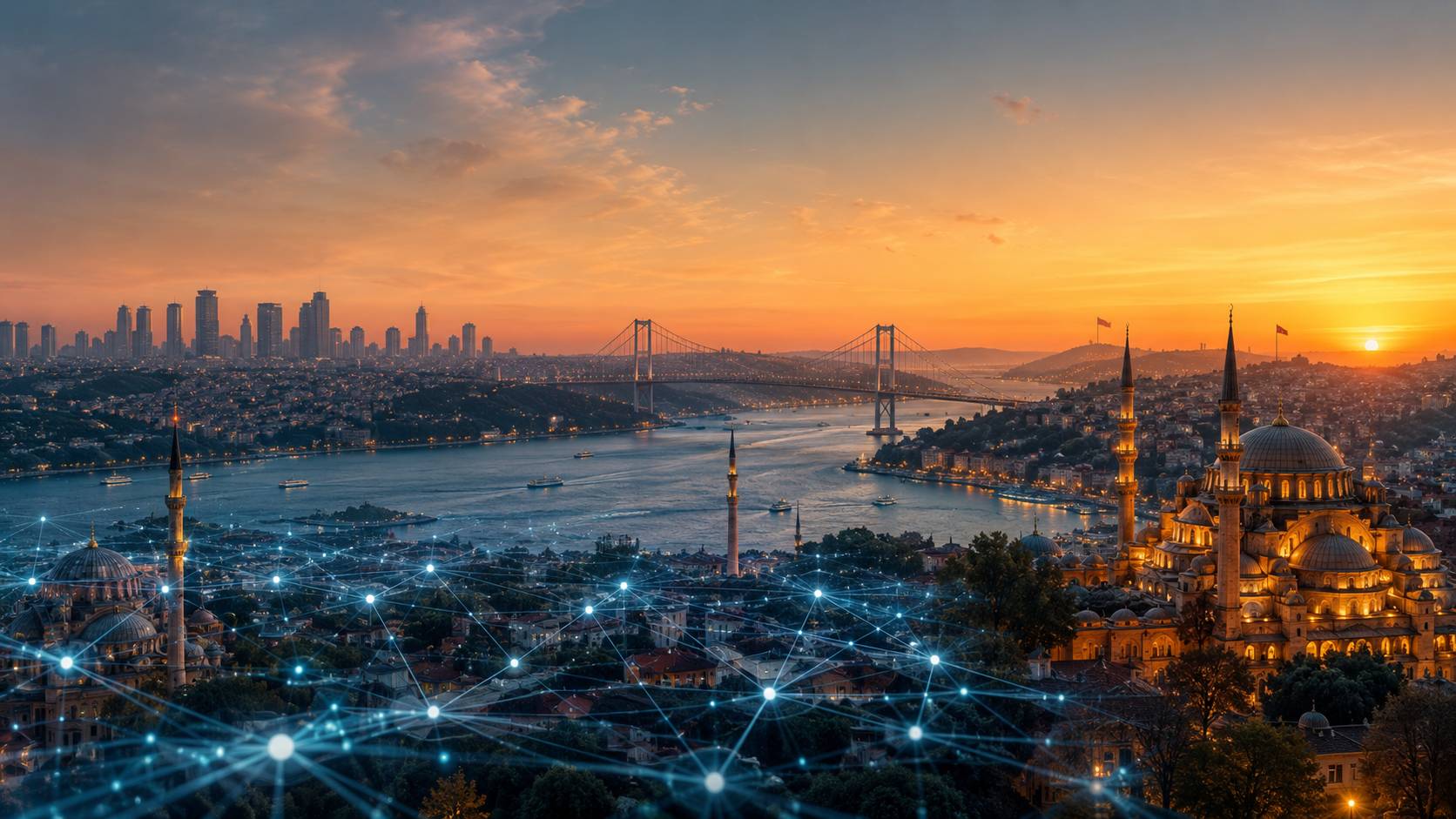
Where Europe, the Middle East, and Central Asia Converge
For years, Istanbul Blockchain Week has occupied a unique position in the crypto conference circuit.
Unlike events centered primarily around North American or Western European markets, Istanbul sits at the intersection of three regions where digital asset adoption, infrastructure investment, and regulatory development are accelerating simultaneously: Türkiye, the Middle East, and Central Asia.
That position has helped turn the conference into more than a networking event. For many companies, it functions as a regional gateway.
The 2026 edition, taking place on June 2–3, arrives as crypto firms increasingly look beyond traditional markets in search of growth. Türkiye remains one of the world’s most active retail crypto markets, with Chainalysis data showing nearly $200 billion in annual transaction volume, the highest in the MENA region.
At the same time, Gulf markets continue expanding their digital asset ecosystems through regulatory frameworks, institutional participation, and blockchain investment initiatives. The UAE has emerged as one of the world’s leading crypto hubs, supported by dedicated virtual asset regulation and growing investor inflows.
Further east, Central Asia is developing its own digital asset infrastructure. Kazakhstan, Uzbekistan, and Kyrgyzstan have moved toward structured crypto frameworks, while new investment vehicles, licensing systems, and blockchain initiatives continue appearing across the region.
That combination makes Istanbul one of the few places where teams targeting all three markets can meet in a single location.
A Meeting Point Between Three Regions
The appeal of Istanbul Blockchain Week increasingly comes from geography as much as technology.
For many companies attending, the objective is not simply visibility. It is integration. Partnership discussions increasingly focus on liquidity access, exchange infrastructure, payment rails, distribution channels, and regional expansion strategies.
SwapSpace at Istanbul Blockchain Week will focus on partner meetings, API integration opportunities, and liquidity discussions. The crypto exchange aggregator connects users with swap offers from 45 liquidity providers through a single interface, supporting 3,300+ cryptocurrencies and over 600,000 exchange pairs. During the event, the team plans to meet with wallets, exchanges, and Web3 platforms.
As digital asset markets become more interconnected, access to reliable liquidity infrastructure has become a competitive advantage rather than a backend technical feature.
Emerging-Market Demand Is Reshaping Liquidity Access
The growth of crypto adoption across Türkiye, the Gulf, and Central Asia is creating new pressures on exchanges and infrastructure providers.
Users increasingly expect access to broader asset selection, better execution quality, and seamless movement between ecosystems. At the same time, liquidity remains fragmented across centralized exchanges, decentralized protocols, market makers, and regional trading venues.
That fragmentation is increasing demand for aggregation and routing infrastructure capable of connecting multiple liquidity sources through a single access layer.
Industry discussions around liquidity are expected to feature prominently throughout Istanbul Blockchain Week, particularly as stablecoins, tokenized assets, and cross-chain financial products continue expanding.
SwapSpace’s presence at the event reflects those shifts. “Istanbul has become a key meeting point for the crypto industry because it connects several of the world’s fastest-growing adoption markets across Türkiye, the Middle East, and Central Asia. As crypto usage expands in these regions, we’re seeing growing demand for broader liquidity access and more exchange options. Our recent DEX integrations are a direct response to those evolving market needs,” said Vasily Shilov, CBDO at SwapSpace.
The trend reflects a wider market transition toward interoperability, where users expect access to liquidity regardless of chain, exchange, or ecosystem.
Why Being Found Is the Next Regional Challenge
Expanding into a new market involves more than infrastructure and partnerships.
Visibility becomes its own challenge. Search behavior differs by region. Media authority differs by region. Publications that carry influence in Europe may have limited reach in the Gulf or Central Asia, while regional outlets often play a larger role in shaping market perception than international media alone.
That has created growing demand for data-driven approaches to media selection and narrative distribution. Outset Media Index analyzes media outlets using factors such as discoverability, syndication depth, domain authority, editorial flexibility, and long-term visibility potential. The framework was developed to help companies identify which publications carry authority within specific markets rather than relying solely on traffic metrics.
As AI-assisted search and recommendation systems become increasingly important, visibility is becoming more closely tied to machine-readable authority and distribution quality.
What This Means for Projects Entering the Region
For companies entering Türkiye, the Middle East, or Central Asia, expansion increasingly depends on regional positioning rather than simple market entry.
Partnerships often come before product launches. Distribution frequently matters as much as technology. Narrative localization has become part of infrastructure strategy.
Outset PR, which will participate in Istanbul Blockchain Week as a sponsor, focuses on helping Web3 companies build earned-media visibility based on measurable authority signals rather than publication volume alone.
The agency uses data from Outset Media Index to analyse how publications perform across discoverability, syndication networks, search visibility, and long-term distribution value. That approach helps identify which outlets are most relevant for specific regional markets instead of treating media coverage as a volume-driven exercise.
Its targeted media outreach model focuses on publication selection based on audience relevance, authority, and visibility potential. For projects entering new markets, that can influence how quickly narratives gain traction across local ecosystems.
As regional crypto competition intensifies, companies are increasingly treating communications as part of market infrastructure rather than a separate marketing function. Through its broader Web3 communications practice at Outset PR, the agency works on founder positioning, earned media strategy, and visibility planning designed around long-term discoverability rather than short-term exposure.
Why the Meeting Point Matters
The significance of Istanbul Blockchain Week extends beyond the conference itself.
The event sits at the intersection of several of the fastest-moving digital asset markets globally, bringing together companies focused on liquidity, infrastructure, regulation, and regional expansion.
As adoption continues growing across Türkiye, the Middle East, and Central Asia, the ability to access liquidity, form partnerships, and maintain visibility across multiple ecosystems is becoming increasingly important.
In that environment, infrastructure and discoverability are starting to follow the same logic: both depend on being connected to the right networks.
Disclaimer: This article is provided for informational purposes only. It is not offered or intended to be used as legal, tax, investment, financial, or other advice.