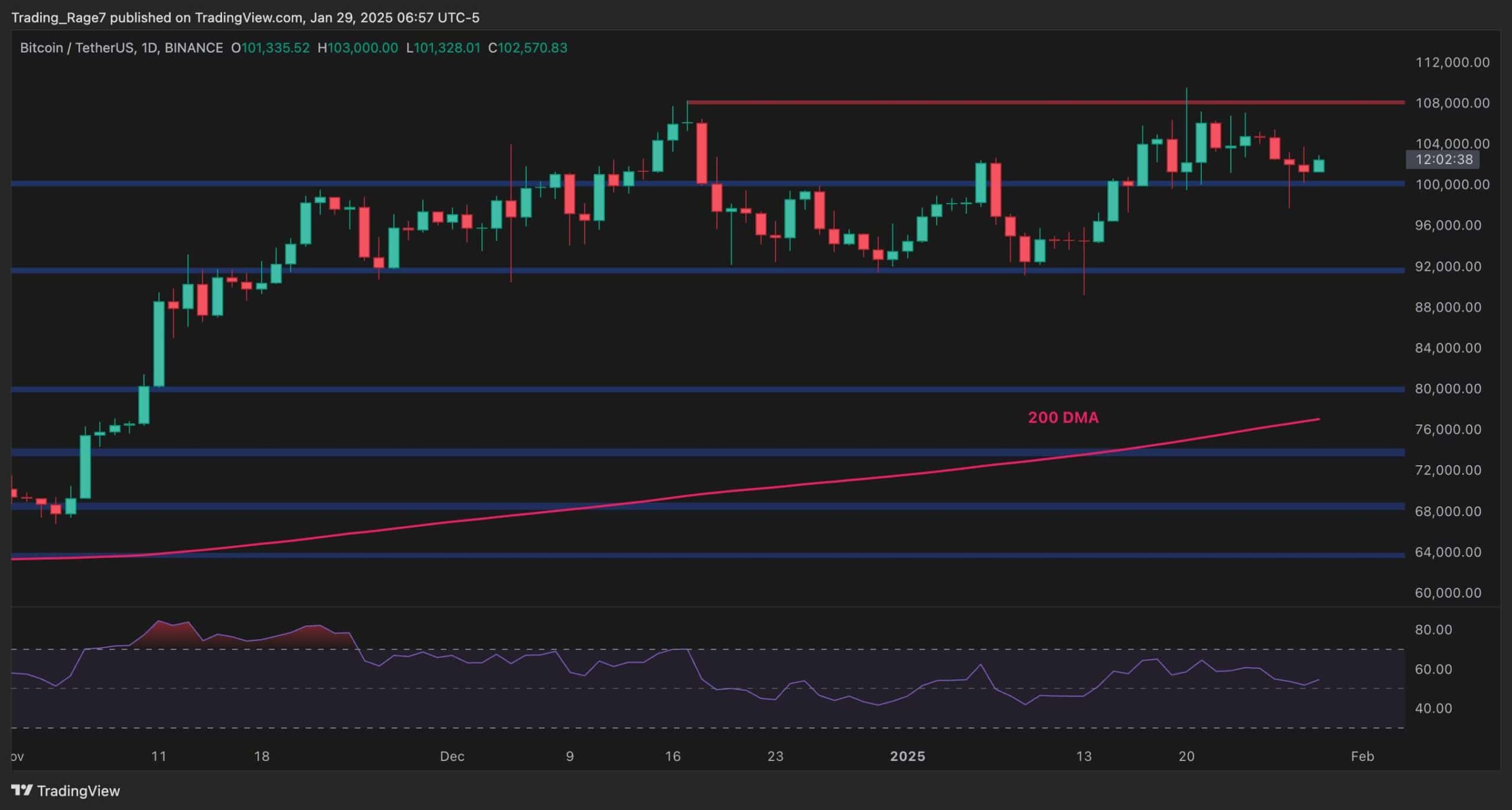
Dollar strength tends to reshape crypto behavior. When the greenback firms up against other currencies, global users often want more USD exposure, not less. In that setting, payment stablecoins can become the most convenient way to hold, send, and price in dollars—sometimes outpacing Bitcoin’s utility in day-to-day transactions.
That dynamic is back in focus after the U.S. dollar index touched roughly 100.21 on June 8, 2026, the highest since April, a two-month peak that highlights renewed demand for USD liquidity overseas (Reuters (republished on StreetInsider)).
At the same time, new corporate and exchange rails are pushing stablecoins deeper into mainstream payments and remittances, potentially making them the clearest beneficiary of a strong-dollar phase.
This piece unpacks why USD firmness can lift payment tokens more than BTC, what to monitor, and how operators can manage the risks.
| Point | Details |
|---|---|
| Dollar strength as demand signal | A rising DXY can increase global desire to hold and transact in USD, channeling flows toward dollar-pegged stablecoins. |
| New rails expand access | MoneyGram’s MGUSD on Stellar and Western Union’s USDPT via Bybit broaden fiat-to-stable onramps across corridors. |
| Liquidity base is large | Industry trackers show stablecoin market cap near $320B in early June 2026, supporting deeper utility and settlement capacity (Datawallet). |
| BTC vs stablecoins in payments | Bitcoin’s volatility and non-USD nature complicate pricing and FX risk; stablecoins align with merchants’ USD preferences. |
| Key risks | Depegs, issuer and banking risk, regulatory shifts, and chain congestion can quickly reverse stablecoin advantages. |
When Dollar Strength Meets On-Chain Money
Editor’s note: We saw treasurers delay conversions back to local currency, and spreads on off-ramps widen during stress. The MGUSD and USDPT updates landed right into that environment, giving compliance teams brand-backed options to trial. In trading chats, market makers flagged net stablecoin issuance as a better barometer for near-term activity than alt rotation. It reinforced my view that, in a strong-USD tape, payment tokens quietly do the heavy lifting. — Idris Calloway
For many households and merchants outside the U.S., a stronger dollar makes saving or invoicing in USD more attractive. Crypto offers a parallel banking rail for achieving that outcome without opening a U.S. bank account. The most straightforward tool is a regulated dollar stablecoin on a fast, low-fee chain.
Recent price action underscores the backdrop. The U.S. dollar index (DXY) hovered around 100.21 on June 8, 2026, a two-month high, signaling tighter global USD conditions and renewed appetite for dollar balances (Reuters (republished on StreetInsider)). In such tapes, the market’s “need-a-dollar-now” use cases—payroll, invoices, remittances—often expand.
Bitcoin thrives on censorship resistance, scarcity, and long-term store-of-value appeal. But when users want a USD unit of account, stablecoins satisfy that demand with the least friction. A stronger dollar can therefore elevate stablecoin velocity and issuance more directly than it lifts BTC’s medium-of-exchange role.
Stablecoins Behave Like Dollar Exports
Think of stablecoins as a software layer that exports American unit-of-account convenience. Merchants can quote in dollars, workers can accept dollar wages, and savers can keep a USD balance—all without local banks intermediating every step. The peg compresses FX uncertainty, while certain chains minimize transfer cost and confirmation time.
Remittance and invoice mechanics
When DXY rises, the local-currency cost of a dollar remittance increases. Yet, senders and receivers still prefer the USD settlement unit to avoid further FX drift. Stablecoins streamline that behavior: convert local currency to a stablecoin, transmit on-chain, and cash out locally or keep the USD-denominated balance for future spending.
In strong-USD periods, the “unit of account” advantage often matters more than speculative upside. That tends to favor stablecoins over BTC for payments.
Recent Rails Matter: MGUSD, USDPT, and Access
The case for payment stablecoins is not theoretical; new rails are shipping:
- MoneyGram announced MGUSD, a U.S. dollar stablecoin issued by Bridge (a Stripe company), native to the Stellar network, with custody by Fireblocks (MoneyGram / PR Newswire). The move integrates a well-known remittance brand with on-chain USD liquidity.
- Bybit said it integrated Western Union’s USDPT (a Solana-based stablecoin), opening selected Latin American markets to USDPT access through fiat onramps (Investing.com).
- Industry trackers put total stablecoin market capitalization near $320 billion in early June 2026, signaling deep liquidity pools for settlement and market-making (Datawallet).
Rails matter because payments adoption is all about access, trust, and cost. A stronger dollar increases the desire for USD balances; broader fiat onramps and brand familiarity convert that desire into actual stablecoin flows.
Pro tip: Watch where corporate treasurers and payroll providers plug in. If they choose chains with fast finality and cheap fees (e.g., Solana or Stellar), expect corridor-specific volume spikes long before the headlines catch up.

Why BTC May Lag As ‘Payments’ When USD Is Ascendant
Bitcoin is not broken as a payment tool; it is just suboptimal for USD-denominated commerce during strong-dollar periods. Merchants face price risk if they accept BTC but account in dollars. Hedging is possible but adds steps and cost, and fiat settlement often reintroduces banking friction that stablecoins already minimize.
| Dimension | Stablecoins (USD-pegged) | Bitcoin (BTC) |
|---|---|---|
| Unit of account alignment | Matches USD pricing; minimal FX risk for USD-ledgers | Non-USD asset; requires real-time FX conversion |
| Volatility exposure | Pegged; price variance mainly in spread/fees | High; merchant assumes mark-to-market risk |
| Settlement cost/time | Low/fast on modern L1s; near-card-like UX | Variable; L1 fees/time can be higher without L2s |
| Accounting simplicity | USD-denominated books stay native | Requires FX gains/losses treatment |
| Consumer familiarity | Feels like “digital dollars” | Feels like an investment asset |
| Regulatory posture | Issuer disclosures/controls vary by product | Asset is bearer; compliance shifts to on/off-ramps |
None of this invalidates BTC’s role as a long-term hedge or savings vehicle. It simply clarifies why, in a strong-USD macro, payment volumes and new user acquisition can skew toward stablecoins.
Investor and Operator Playbook
For payments companies and treasurers
- Map corridor economics: compare card, bank wire, and on-chain fee stacks at target volumes. Include FX spreads and cash-out costs.
- Select chain by SLA, not hype: favor low-latency, low-fee, high-uptime networks with robust tooling and custody support.
- Diversify issuers: do not rely on a single stablecoin. Maintain policies for redemptions, blacklisting events, and reserve transparency reviews.
- Design for volatility: even with USD pegs, assume spread spikes during market stress. Pre-fund liquidity buffers at key exchanges/OTC desks.
- Compliance as UX: embed KYC/AML flows that match local norms; anticipate travel rule messaging and sanctions screening on both sides.
For traders and allocators
- Track the stablecoin supply ratio (SSR) and aggregate issuance/redemptions. Rising supply in a firm-USD backdrop can flag growing on-chain dollar demand.
- Watch basis and funding: stable-heavy collateral environments can compress perps funding and basis spreads; adapt strategies accordingly.
- Follow corridor news: integrations like MGUSD and USDPT often precede localized volume growth. Trade the liquidity, not the press release.
- Yield hygiene: stablecoin yields often reflect T-bill proxies or on-chain lending risk. Scrutinize venue risk and rehypothecation.
Pro tip: During macro stress, spreads on fiat off-ramps can widen faster than on-chain fees. Having multiple cash-out partners per corridor can be the difference between uptime and outages.
Metrics To Monitor In A Strong-USD Tape
- DXY and local FX crosses: Sustained USD strength can pull new users into dollar stablecoins. Note inflection points and volatility clusters.
- Stablecoin net issuance: Track on-chain supply changes for major issuers. Net mints often correlate with rising demand for on-chain dollars.
- CEX/DEX stable pairs share: A growing portion of spot volume against stables indicates deepening dollarized liquidity.
- On-chain settlement latency/fees: Monitor median fees and time-to-finality on relevant L1s. Payment UX depends on predictable performance.
- Off-ramp spreads by corridor: Measure fiat cash-out slippage versus official rates. Spikes can signal stress or capital controls.
- Issuer transparency: Review attestation cadence, reserve composition, and redemption mechanics. Stronger USD can stress-test issuers’ liquidity.
- Regulatory headlines: Licensing updates, reserve rules, or cross-border data-sharing agreements can materially shift adoption curves.
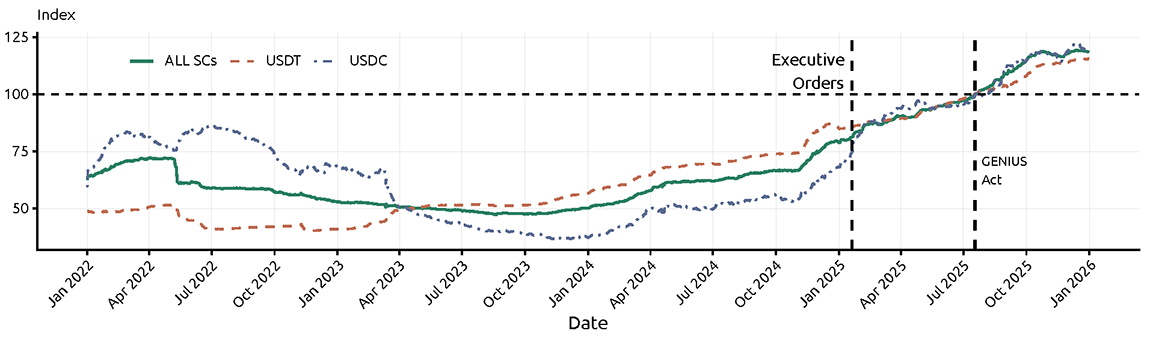
Figure 1 from the Federal Reserve FEDS Note: indexed market capitalization of stablecoins (All SCs, USDT, USDC) showing rapid growth since mid‑2025 — illustrates the scale of dollar‑denominated stablecoin supply and why USD demand can materially affect payment‑token dynamics. — Source: Federal Reserve Board — FEDS Notes (“Stablecoins in 2025”)
Risks That Can Flip The Thesis
Stablecoins concentrate several categories of risk that can overpower macro tailwinds:
- Depegs and reserve shock: Redemptions can surge during market breaks. Limited transparency or asset-liability mismatches increase fragility.
- Issuer and banking exposure: Custodial concentration or bank failures can disrupt mint/burn flows, even if on-chain transfers continue.
- Regulatory intervention: New restrictions on issuance, advertising, or cross-border use can choke corridor growth overnight.
- Sanctions and blacklisting: Compliance actions may freeze addresses or entire venues, impairing fungibility for certain users.
- Chain outages/congestion: Payment UX degrades rapidly if finality slows or fees spike; users revert to cash or cards.
- USD reversals: If the dollar weakens materially, some users may prefer local currency or pivot to BTC for upside, reducing stablecoin velocity.
Risk reminder: None of these instruments are risk-free. Smart-contract and counterparty exposures are real. Do not assume a peg will hold under all conditions.
How the Next Year Could Look Across Corridors
Corridors with high remittance intensity and inflationary local currencies are most sensitive to USD cycles. If DXY remains firm, expect more MSMEs and gig workers to accept stablecoins for speed and USD exposure, with domestic cash-outs happening less frequently and balances held longer in dollar form.
Rails announced by established money transmitters can accelerate that curve. MoneyGram’s MGUSD on Stellar uses brands and custody partners familiar to compliance teams (MoneyGram / PR Newswire). Western Union’s USDPT availability via Bybit begins in select Latin American markets, where remittance needs are pronounced (Investing.com). As such integrations roll out, they create habit loops—users learn to request and hold dollars on-chain first, then spend locally.
Meanwhile, Bitcoin’s role in these corridors can tilt toward savings and long-term optionality rather than daily payments. That’s not bearish on BTC—just realistic about which tool addresses which job when the dollar is in the driver’s seat.
Crypto Daily tracks these adoption threads and the market structure behind them. For ongoing coverage of stablecoin rails, BTC market dynamics, and policy shifts, visit Crypto Daily.
Frequently Asked Questions
Does a higher DXY always increase stablecoin usage?
Not always, but it often correlates with stronger global USD demand. When local currencies weaken, users value USD-denominated balances, and stablecoins can be the easiest path to get them. Local regulation, access, and fees still determine actual uptake.
Why would stablecoins benefit more than Bitcoin from a stronger USD?
Because most payments and invoices are dollar-denominated. Stablecoins align with that unit of account, removing FX volatility. Bitcoin remains compelling for savings, but its price swings and non-USD nature add friction to everyday commerce.
What recent developments support broader stablecoin access?
MoneyGram launched MGUSD on Stellar with Bridge (a Stripe company) as issuer and Fireblocks custody, and Bybit integrated Western Union’s USDPT for select Latin American markets via fiat onramps (MoneyGram / PR Newswire; Investing.com).
How big is the stablecoin market now?
Industry trackers indicated about $320 billion in total stablecoin market capitalization in early June 2026, reflecting substantial liquidity for settlement (Datawallet).
Which metrics should businesses watch before accepting stablecoins?
Monitor DXY trends, on-chain fees and finality times, issuer attestations and redemption mechanics, and local off-ramp spreads. Also assess corridor-specific regulation and sanctions exposure.
What are the main risks in relying on stablecoins for payments?
Depeg events, issuer or custodian failures, regulatory restrictions, sanctions blacklisting, and chain congestion. Operators should diversify issuers and off-ramps, and maintain liquidity buffers.
Will Bitcoin lose relevance if stablecoins dominate payments?
Unlikely. Bitcoin serves different jobs—long-term store of value and censorship-resistant settlement. Stablecoin success in payments doesn’t preclude BTC’s investment and savings role.
Disclaimer: This article is provided for informational purposes only. It is not offered or intended to be used as legal, tax, investment, financial, or other advice.